







Introduction
If you are searching for a Non VBV BIN List 2026, you are likely looking for BINs that are not enrolled in Verified by Visa or Mastercard SecureCode. You want to understand which BINs work, why they work, and how to use this information. This guide covers everything you need to know about Non VBV BINs for the USA, UK, Canada, and Australia.
We will explain what a BIN is, what information it provides, and why a BIN list cannot guarantee a card is non-VBV. We will also discuss the difference between six-digit and eight-digit BINs, account ranges, and why country-specific lists matter. This is a purely educational resource designed to help you understand the technical side of BINs and 3D Secure.
Important Note: This guide is for educational purposes only. Always comply with local laws and payment card industry rules.

What Is a Non VBV BIN List?
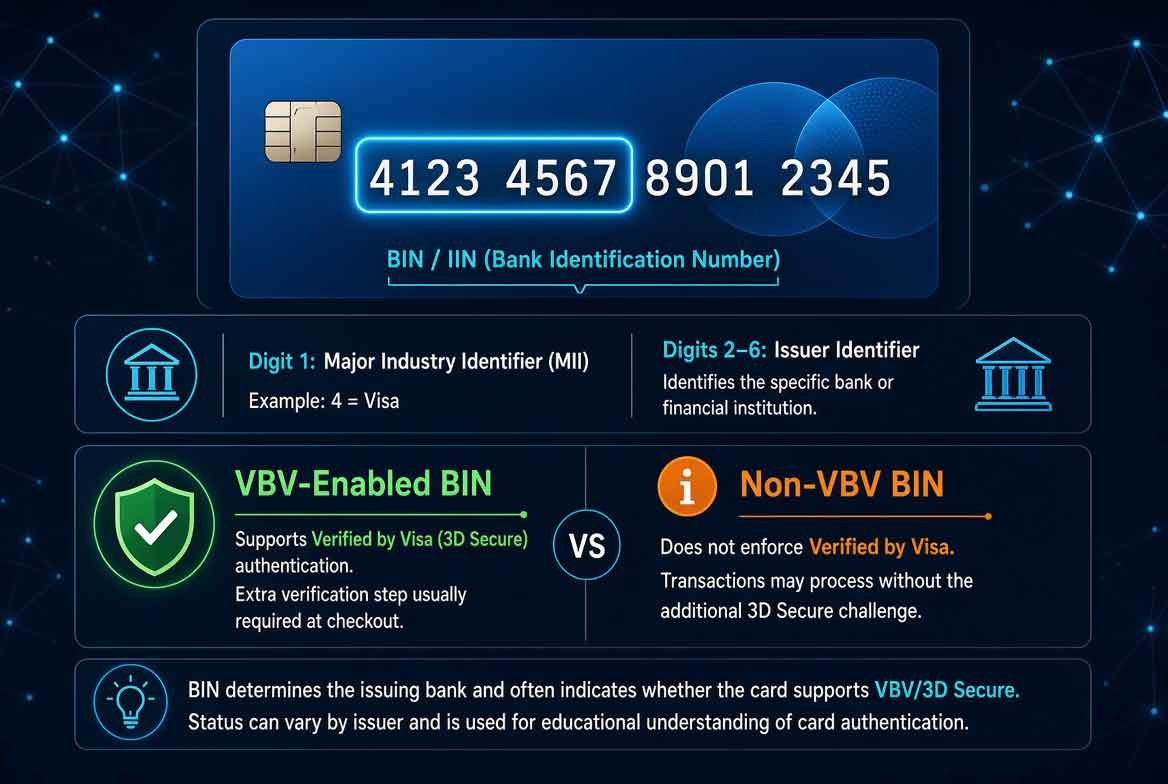
A Non VBV BIN List is a compilation of Bank Identification Numbers (BINs) that are not enrolled in Verified by Visa (VBV) or Mastercard SecureCode. VBV is a 3D Secure authentication protocol that requires cardholders to enter a password or one-time code during online transactions. Non-VBV BINs are associated with cards that do not trigger this authentication step.
Why does this matter? For merchants, non-VBV transactions mean fewer checkout drop-offs. For others, it means accessing cards that do not require additional verification. A BIN list typically includes the BIN, card type (credit or debit), issuing bank, card brand (Visa, Mastercard, Amex, Discover), and whether the BIN is VBV or non-VBV.
However, a BIN list is only a starting point. It provides information about the card type and issuer but cannot guarantee a specific card will not require 3DS. That depends on the cardholder’s bank settings and the merchant’s gateway configuration.
What Information Does a BIN Actually Provide?
A BIN (Bank Identification Number) is the first six to eight digits of a card number. It identifies the issuing bank, card brand, card type (credit, debit, prepaid), and sometimes the card level (standard, gold, platinum, etc.).
Example BIN: 411111 (Visa, not real)
A BIN lookup can reveal:
- Issuing bank name
- Card brand (Visa, MC, Amex, Discover)
- Card type (credit, debit, prepaid)
- Card level (standard, gold, platinum, etc.)
- Country of issuance
- Whether the BIN is VBV or non-VBV (based on historical data)
What a BIN cannot tell you:
- Cardholder name
- Card expiration date
- CVV/CVC
- Card balance
- Whether a specific card is currently active
- Whether a specific card will trigger 3DS at checkout
BIN data is static, but card behavior is dynamic. A BIN that was non-VBV last month may now be enrolled in VBV. That is why relying solely on a static BIN list is risky.
Non-VBV BINs USA
The United States has a high volume of non-VBV BINs, primarily because many US banks did not enforce 3D Secure until recently. US card issuers have been slower to adopt VBV compared to Europe. As a result, many US BINs remain non-VBV.
Key US BIN characteristics:
- Many Visa and Mastercard credit cards are non-VBV.
- Debit cards often have VBV enabled, but some still pass through without verification.
- American Express and Discover rarely use 3D Secure in the US.
- Prepaid cards and virtual cards are often non-VBV.
Example US BIN: 414720 (Visa Credit, non-VBV)
Where to find updated US non-VBV BINs: Trusted vendors like worlddumps.site offer regularly updated BIN lists, dumps with pin, and CVV cards. For physical clone cards, clonecards.store delivers premium clone cards discreetly. For money transfer services, cvvdump.uno provides Cashapp, PayPal, Venmo, Zelle, Bank, and Western Union transfers.
Non VBV BINs UK
The UK has more strict 3D Secure enforcement due to Strong Customer Authentication (SCA) regulations. However, not all UK cards are enrolled in VBV. Some BINs still pass through without verification.
Key UK BIN characteristics:
- Many UK debit cards have VBV enabled.
- Credit cards from some banks are non-VBV.
- Prepaid cards and virtual cards are often non-VBV.
- UK BINs may require a proxy to test.
Example UK BIN: 492942 (Visa Debit, non-VBV)
Tip: Use a UK proxy when testing non-VBV BINs to avoid triggering location-based authentication.
Non VBV BINs Canada
Canada has a mix of VBV and non-VBV BINs. Some Canadian banks enforce 3DS, while others do not. Canadian BINs are often similar to US BINs in terms of card type distribution.
Key Canadian BIN characteristics:
- Visa and Mastercard credit cards are often non-VBV.
- Debit cards from major banks may have VBV enabled.
- Prepaid cards are frequently non-VBV.
- American Express is rarely VBV in Canada.
Example Canadian BIN: 453601 (Visa Credit, non-VBV)
Non VBV BINs Australia
Australia has strict SCA enforcement similar to the UK. However, some Australian BINs remain non-VBV.
Key Australian BIN characteristics:
- Many Australian debit cards have VBV enabled.
- Credit cards from smaller banks may be non-VBV.
- Prepaid cards and travel cards are often non-VBV.
- Australian BINs may require an Australian proxy to test.
Example Australian BIN: 446200 (Visa Credit, non-VBV)
Why Country Doesn’t Determine 3D Secure
Many people think that cards from the USA are automatically non-VBV, while UK cards are always VBV. This is false. 3D Secure enrollment depends on the issuing bank, not the country. Some US banks have VBV enabled, and some UK banks do not.
Factors that affect 3D Secure:
- Issuing bank policies
- Card type (credit vs debit)
- Card level (standard vs premium)
- Merchant gateway settings
- Transaction amount and risk profile
A country-specific BIN list is useful, but you must verify each BIN individually.
Non VBV BIN List 2025 vs 2026
The difference between a 2025 and 2026 list is that banks update their 3D Secure enrollment over time. A BIN that was non-VBV in 2025 may become VBV in 2026. Therefore, an updated list is critical.
What changed from 2025 to 2026:
- More US banks adopted VBV.
- UK banks tightened SCA enforcement.
- Canadian banks began rolling out 3DS.
- Australian banks followed SCA regulations.
Always use the most recent data. Vendors like worlddumps.site update their BIN lists regularly.
Why Static BIN Lists Become Outdated
A static BIN list is a snapshot of data at a specific time. Banks change their 3D Secure enrollment, card types, and BIN ranges regularly. A list from six months ago may have many BINs that are now VBV.
Why lists become outdated:
- Banks update their authentication protocols.
- New BIN ranges are issued.
- Old BINs are retired.
- Card types change (debit to credit, etc.).
Solution: Use dynamic BIN databases or regularly updated lists from trusted sources. Avoid free lists from forums as they are often outdated.
Six-Digit vs Eight-Digit BINs
ISO standard BINs are six digits. However, many issuers now use eight-digit BINs to increase capacity. Eight-digit BINs provide more granular information about the card.
Six-digit BIN: Identifies the issuer and card brand. Eight-digit BIN: Identifies the issuer, card brand, card type, and sometimes the card level.
Example: 411111 (six-digit) vs 41111100 (eight-digit)
Why this matters: Eight-digit BINs are more precise for non-VBV identification. However, some older systems only recognize six digits.
What Is an Account Range?
An account range is a sequence of card numbers within a BIN that share similar characteristics. For example, a BIN may have an account range of 123456000000 to 123456999999. Cards within that range may have the same VBV status, but not always.
Account ranges help:
- Identify which cards within a BIN are non-VBV.
- Reduce risk of using a VBV card from a partially enrolled BIN.
Limitation: Account ranges are not always publicly available and require access to a BIN database.
Are USA, UK, Canada and Australia BIN Lists Different?
Yes. Each country has its own BIN ranges and issuing banks. A US BIN list will contain BINs from US banks, while a UK list will contain UK bank BINs. However, the structure is the same: BIN, card brand, card type, and VBV status.
Key differences:
- US lists have more non-VBV BINs.
- UK lists have fewer non-VBV BINs due to SCA.
- Canada lists are similar to US but with some VBV enforcement.
- Australia lists are similar to UK.
Best practice: Use country-specific lists for targeted carding.
What About Non VBV Debit BINs?
Debit cards are often more difficult to find non-VBV because banks enforce 3DS on debit transactions. However, some debit BINs remain non-VBV, especially from smaller banks or prepaid debit cards.
Where to find non-VBV debit BINs:
- Prepaid debit cards (e.g., Netspend, Green Dot)
- Virtual debit cards
- Bank debit cards from smaller institutions
Example: BIN 533111 (Mastercard Debit, non-VBV)
What Is a Non-VBV Card List?
A Non-VBV Card List is similar to a BIN list but includes specific card numbers or ranges that are known to be non-VBV. This is more precise than a BIN list because it targets individual cards.
Difference between BIN list and card list:
- BIN list: Provides BIN and VBV status.
- Card list: Provides full card numbers (or ranges) with VBV status.
Risk: Card lists are often stolen data and are illegal to possess. BIN lists are public information.
Can a BIN List Tell You a Card’s Balance?
No. A BIN list cannot tell you a card’s balance. Balance information is stored on the card issuer’s server and is not encoded in the BIN. You need access to the cardholder’s account to know the balance.
Common myth: Some people think BINs indicate card balance. This is false.
Can a BIN List Guarantee No 3DS?
No. A BIN list can indicate that a BIN was historically non-VBV, but it cannot guarantee that a specific card will not trigger 3DS at checkout. Factors such as the cardholder’s bank settings, the merchant’s gateway, and the transaction amount can all affect 3DS.
Why no guarantee:
- Banks can enable VBV on individual cards within a BIN.
- Merchants can configure their gateway to require 3DS.
- Some transactions are randomly selected for 3DS.
Best approach: Test each card before relying on it.
Why “Non VBV Websites” Is a Different Search
“Non VBV Websites” refers to online stores or payment gateways that do not require 3D Secure for transactions. This is different from a BIN list. A non-VBV website is a merchant that has disabled 3DS on their checkout.
Examples of non-VBV gateways:
- Some high-risk merchant accounts
- Certain payment processors
- Custom checkout systems
Why this matters: Even if you have a non-VBV card, the website must also accept non-VBV transactions. Some websites force 3DS regardless of the card.
How to Evaluate a BIN List
When evaluating a BIN list, consider:
- Source: Is it from a trusted vendor or a random forum?
- Date: How recent is the data?
- Coverage: Does it include your target country and card types?
- Accuracy: Test a sample of BINs to verify.
- Format: Is it easy to use (CSV, text, etc.)?
Red flags:
- Free lists from unknown sources
- Lists claiming 100% non-VBV guarantee
- Lists without dates
Recommended source: worlddumps.site offers regularly updated BIN lists with verified data.
Official BIN Data vs Random BIN Lists
Official BIN data comes from card networks (Visa, Mastercard) and is used by merchants for routing. Random BIN lists are compiled by individuals and may be inaccurate.
Official BIN data:
- Accurate for card type and issuer
- Does not include VBV status
- Requires subscription
Random BIN lists:
- May include VBV status
- Often outdated
- Risk of inaccuracy
Best practice: Use official data for card identification and verified lists for VBV status.
What a BIN List Cannot Tell You
A BIN list cannot tell you:
- Cardholder name
- Card expiration date
- CVV/CVC
- Card balance
- Whether a card is currently active
- Whether a specific transaction will trigger 3DS
Remember: A BIN list is a tool, not a guarantee.
FAQ
What Is a Non VBV Credit Card? A credit card that is not enrolled in Verified by Visa or Mastercard SecureCode. It does not require a password or one-time code during online checkout.
What Is a Non VBV Debit Card? A debit card that is not enrolled in 3D Secure. Less common than non-VBV credit cards.
What Does “Non Verified by Visa” Mean? It means the card does not participate in Visa’s 3D Secure program. Transactions with that card will not prompt a VBV verification step.
Can a BIN Number Be Used to Identify a Card? Yes, a BIN identifies the issuing bank, card brand, and card type. It does not identify the cardholder.
What Is a BIN Number Checker? A tool that looks up BINs to reveal issuer, brand, type, and sometimes VBV status.
How to Check if a Card Is VBV or Non-VBV? Use a BIN lookup tool or test the card on a website that supports 3DS. If prompted for verification, it is VBV.
VBV for Merchants and Websites: Enabling 3D Secure Merchants can enable or disable 3DS on their payment gateway. Disabling 3DS increases conversion but also increases fraud risk.
Non-VBV Gateways: How Payment Gateways Handle Non-3DS Transactions Some gateways allow non-3DS transactions by default. Others require the merchant to opt out.
Conclusion
A Non VBV BIN List is a valuable resource for understanding which cards are not enrolled in 3D Secure. However, it is not a guarantee. Use updated lists from trusted sources, test cards before relying on them, and always comply with local laws.


