







Introduction (Bitcoin Non VBV BINs)
The world of online payments is complex. Terms like VBV, MSC, 3D Secure, and Non VBV BINs get thrown around constantly. But what do they actually mean, especially when combined with Bitcoin and cryptocurrency transactions?
This guide explains everything you need to know about Bitcoin Non VBV BINs in 2026. We will cover what VBV and MSC stand for, how BIN lists work, whether Non VBV cards still exist, and why people still search for them. Whether you are a beginner or an experienced user, this article provides clear answers.
Also read: How to Check Non VBV BINs in 2026
What Is a BIN? (Bitcoin Non VBV BINs)
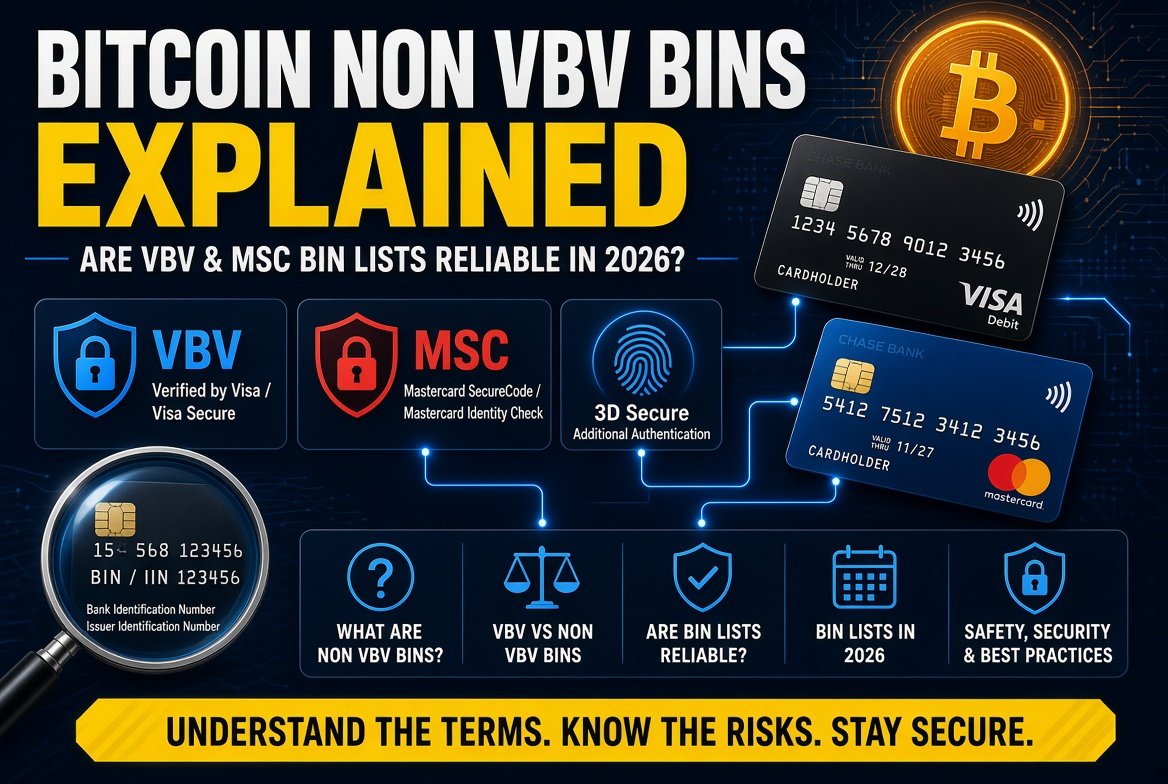
A BIN, or Bank Identification Number, is the first six digits of a credit or debit card. These digits identify the issuing bank, the card brand, the card type, and the card level.
Every card has a BIN. When you make an online payment, the payment gateway uses the BIN to route the transaction. The BIN tells the system which bank issued the card, whether it is a credit or debit card, and what country it comes from.
BINs are essential for payment processing. They are also used to determine whether a card requires 3D Secure authentication.
What Does Non VBV BIN Mean? (Bitcoin Non VBV BINs)
Non VBV BIN means a Bank Identification Number that is associated with cards not enrolled in Verified by Visa. VBV is Visa’s version of 3D Secure.
When a card is enrolled in VBV, the cardholder must complete an extra verification step during checkout. This usually involves entering a password or a one time code sent to their phone.
A Non VBV BIN means cards from that BIN are not enrolled in this program. Transactions using these cards can proceed without the extra step. This makes them desirable for situations where you want to avoid additional authentication.
Non VBV does not mean the card is stolen or invalid. It simply means the issuer has not enrolled that card in the VBV program.
What Are Bitcoin Non VBV BINs? (Bitcoin Non VBV BINs)
Bitcoin Non VBV BINs are BINs that are used specifically for purchasing Bitcoin or other cryptocurrencies without triggering 3D Secure authentication.
When you buy Bitcoin online, many payment gateways apply 3D Secure to reduce fraud risk. This can cause transactions to fail if the cardholder cannot complete the authentication step.
Bitcoin Non VBV BINs are BINs that have been tested and confirmed to work with cryptocurrency exchanges and platforms without triggering the extra verification. This allows for smoother and faster Bitcoin purchases.
These BINs are not different from regular Non VBV BINs in a technical sense. The term Bitcoin Non VBV BINs simply refers to their use case.
VBV vs Non VBV BINs (Bitcoin Non VBV BINs)
The difference between VBV and Non VBV BINs is simple:
VBV BINs: Cards from these BINs are enrolled in Verified by Visa or other 3D Secure programs. Transactions will trigger an additional authentication step.
Non VBV BINs: Cards from these BINs are not enrolled in these programs. Transactions proceed without the extra step.
VBV BINs offer more security for the cardholder but add friction to the checkout process. Non VBV BINs offer less friction but also less protection against unauthorized use.
For merchants, Non VBV BINs can mean fewer abandoned carts. For others, they mean fewer failed transactions.
What Are MSC BINs? (Bitcoin Non VBV BINs)
MSC stands for Mastercard SecureCode. This is Mastercard’s version of 3D Secure. MSC BINs are BINs that are enrolled in the Mastercard SecureCode program.
Just like VBV for Visa, MSC requires the cardholder to authenticate during checkout. This can be a password, a one time code, or biometric verification.
MSC BINs work the same way as VBV BINs but on the Mastercard network. When people talk about Non VBV BINs, they often mean Non 3D Secure BINs in general, which includes both Visa and Mastercard cards.
Verified by Visa vs Visa Secure (Bitcoin Non VBV BINs)
Verified by Visa (VBV) was the original name for Visa’s 3D Secure program. In recent years, Visa rebranded it as Visa Secure.
The functionality is the same. The name changed to reflect updates to the program.
Visa Secure includes the same authentication steps as VBV but with improved technology. It uses risk based authentication, which means not all transactions trigger the extra step. Only transactions deemed high risk require authentication.
This is important because it means some Visa cards that were previously Non VBV may now trigger authentication under certain conditions.
Also read: How to Check Non VBV BINs in 2026
Mastercard SecureCode vs Mastercard Identity Check (Bitcoin Non VBV BINs)
Mastercard SecureCode was the original name for Mastercard’s 3D Secure program. It has been rebranded as Mastercard Identity Check.
Again, the functionality is similar. Identity Check uses risk based authentication to decide when to challenge the cardholder.
This means that even cards that were previously Non MSC may now trigger authentication in some cases. The shift to risk based authentication has made the concept of Non VBV BINs more complex.
What Is 3D Secure? (Bitcoin Non VBV BINs)
3D Secure is a security protocol used by Visa, Mastercard, American Express, and Discover. It adds an extra layer of verification for online transactions.
The 3D stands for Three Domains. The three domains are the merchant, the issuing bank, and the payment network.
When a card is enrolled in 3D Secure, the transaction is redirected to the cardholder’s bank for authentication. The cardholder must enter a password or a one time code to complete the transaction.
3D Secure is designed to reduce fraud. However, it also adds friction to the checkout process. Some merchants prefer to avoid it for this reason.
Why Some Transactions Don’t Show a 3D Secure Challenge (Bitcoin Non VBV BINs)
Not all transactions trigger a 3D Secure challenge. This is because of risk based authentication.
Under risk based authentication, the bank or payment network decides whether to challenge the transaction based on risk factors. These factors include the transaction amount, the merchant, the cardholder’s location, and the device being used.
If the transaction is deemed low risk, it proceeds without a challenge. This means a card that is enrolled in 3D Secure may not always trigger the authentication step.
This is why some transactions appear to be Non VBV even when the card is technically enrolled. The system simply decided the transaction was safe enough to skip the challenge.
Are Non VBV BIN Lists Reliable in 2026? (Bitcoin Non VBV BINs)
Non VBV BIN lists can be reliable if they are updated frequently and sourced from trusted vendors. However, many lists are not reliable.
The reliability of a BIN list depends on:
How often it is updated: Lists updated daily or weekly are more reliable than static lists.
How it is tested: Lists created through live testing against payment gateways are more accurate than lists compiled from guesses.
Who created it: Lists from trusted vendors like Cvvdump.com, Worlddumps.site, and Buyccfullz.site are more reliable than free lists from forums.
In 2026, the shift to risk based authentication has made Non VBV BIN lists less reliable than they were in the past. Even a confirmed Non VBV BIN may trigger authentication under certain conditions.
Why Old Non VBV BIN Lists Become Outdated (Bitcoin Non VBV BINs)
Old Non VBV BIN lists become outdated for several reasons:
Banks update their systems: A bank may enroll all its cards in 3D Secure, making previously Non VBV BINs useless.
Risk based authentication changes: The criteria for triggering authentication can change at any time.
New BINs are introduced: Old lists do not include new BINs.
Old BINs are retired: Banks stop using certain BINs and reissue cards with new ones.
A list from 2024 or early 2025 is likely to have many dead entries in 2026. Using outdated lists leads to failed transactions.
Are BIN Checkers Reliable? (Bitcoin Non VBV BINs)
BIN checkers can be reliable if they are maintained properly. A good BIN checker uses live data and updates frequently.
However, not all BIN checkers are equal. Free checkers often use static databases that are months old. Paid checkers from trusted vendors are more likely to have current data.
When using a BIN checker, look for:
- The date the data was last updated
- Whether the checker performs live tests
- Whether it includes VBV status
- The reputation of the provider
Buyccfullz.site offers an integrated checker that tests BINs against live payment gateways. This is more reliable than static BIN databases.
Can a BIN Tell You Whether a Card Uses 3D Secure? (Bitcoin Non VBV BINs)
A BIN can indicate whether a card is likely to use 3D Secure, but it cannot guarantee it. Here is why:
Risk based authentication: Even if a card is enrolled in 3D Secure, the system may not challenge every transaction.
Mixed BINs: Some BINs contain both enrolled and non enrolled cards. The BIN alone cannot tell you which category a specific card falls into.
Changes over time: A BIN that was Non VBV last month may be VBV this month.
A BIN provides a strong indicator but not a guarantee. For the most accurate information, use a BIN checker that performs live tests.
Are Bitcoin BIN Lists Different? (Bitcoin Non VBV BINs)
Bitcoin BIN lists are not technically different from regular Non VBV BIN lists. The BINs themselves are the same.
The difference is in the use case. Bitcoin BIN lists focus on BINs that work specifically with cryptocurrency exchanges and platforms.
Some BINs that work for regular online purchases may not work for Bitcoin purchases. This is because cryptocurrency transactions are often flagged as high risk by payment gateways.
Bitcoin BIN lists are compiled by testing BINs against cryptocurrency platforms specifically. This makes them more useful for Bitcoin purchases than general Non VBV lists.
Non VBV BINs and Risk Based Authentication (Bitcoin Non VBV BINs)
Risk based authentication has changed the game for Non VBV BINs. Under this system, even cards that are technically enrolled in 3D Secure may not trigger authentication for low risk transactions.
This means that the concept of Non VBV BINs is less clear than it used to be. A BIN that is enrolled in 3D Secure may still work for many transactions without authentication.
However, the opposite is also true. A BIN that is not enrolled may trigger authentication if the transaction is deemed high risk.
For this reason, success with Non VBV BINs depends on more than just the BIN. It also depends on the transaction amount, the merchant, the device, and other factors.
Is Non VBV the Same as No Security? (Bitcoin Non VBV BINs)
No. Non VBV does not mean no security. It simply means the card is not enrolled in the Verified by Visa program.
Cards still have other security features:
CVV: The three digit code on the back of the card.
AVS: Address Verification System.
Velocity checks: Limits on how many transactions can be attempted.
Fraud monitoring: Banks monitor transactions for suspicious activity.
Non VBV cards are not unprotected. They just lack the extra 3D Secure authentication step.
Do Non VBV Cards Still Exist in 2026? (Bitcoin Non VBV BINs)
Yes, Non VBV cards still exist in 2026. However, they are less common than they were in previous years.
Banks around the world have been gradually enrolling more cards in 3D Secure programs. This is driven by regulatory requirements and the need to reduce fraud.
Despite this, many cards remain Non VBV. These include:
- Older cards that were never enrolled
- Cards from smaller issuers that have not updated their systems
- Prepaid cards from certain issuers
- Cards from countries where 3D Secure is not mandatory
Non VBV cards still exist, but finding them requires updated BIN lists and reliable checkers.
Why People Still Search for Non VBV BINs (Bitcoin Non VBV BINs)
People search for Non VBV BINs for several reasons:
Smoother transactions: Avoiding 3D Secure means fewer steps during checkout.
Fewer failures: 3D Secure can cause transactions to fail if the cardholder cannot authenticate.
Bitcoin purchases: Cryptocurrency transactions are often flagged as high risk, making Non VBV BINs useful.
Testing: Some people test BINs to understand how payment gateways work.
Research: Understanding BINs and VBV status is part of learning about online payments.
The demand for Non VBV BINs continues in 2026 because the need for smooth transactions remains.
Frequently Asked Questions on Bitcoin Non VBV BINs
Is there a non VBV bin security in 2026? Non VBV BIN security in 2026 is less reliable than in previous years due to the shift to risk based authentication. However, updated BIN lists from trusted vendors like Cvvdump.com and Worlddumps.site still provide useful data. The key is using frequently updated sources.
What is a non-VBV bin? A non-VBV bin is a Bank Identification Number associated with cards not enrolled in Verified by Visa. This means transactions using these cards do not require the extra 3D Secure authentication step during checkout.
Do you need a list of non-VBV bins & functional CCS? Yes, if you want to avoid 3D Secure authentication during online transactions. Updated lists from trusted vendors provide the most accurate data. Visit Worlddumps.site for Non VBV BINs or Buyccfullz.site for integrated checkers and prepaid cards.
What does VBV stand for in 2026? VBV stands for Verified by Visa. It is Visa’s brand name for the 3D Secure authentication protocol. In recent years, Visa has rebranded it as Visa Secure, but the term VBV is still widely used.
Also read: Amazon Carding With Aged Accounts
Conclusion of Bitcoin Non VBV BINs
Bitcoin Non VBV BINs remain relevant in 2026, but the landscape has changed. Risk based authentication has made the concept of Non VBV BINs more complex. Updated BIN lists and reliable checkers are essential for success.
For the most accurate and current Non VBV BIN data, use trusted vendors who test their data regularly. Visit Worlddumps.site to get Non VBV BINs or Clonecards.store to get clone cards, legit dumps with PIN, and carding materials. Also visit Cvvdump.uno to get money swift money transfer services including bank transfer, PayPal, CashApp, Venmo, Zelle, and Western Union transfers.
Stay informed, use updated sources, and understand that no BIN list can guarantee success in every transaction.


