







Table of Contents
ToggleIntroduction
If you are searching for a reliable non VBV BIN checker in 2026, you are not alone. Thousands of people every day look for tools that can identify BINs that bypass 3D Secure authentication. Whether you are a security researcher testing payment gateways, a developer integrating BIN validation, or someone exploring the world of carding for educational purposes, understanding how BIN checkers work is essential.
But not all BIN checkers are created equal. Many free tools give outdated or incorrect data. Some even log your searches. In this comprehensive guide, we will cover everything you need to know about advanced non VBV BIN checkers, including what they are, how they work, what to look for, and where to find verified, alive BIN lists for 2026.
Get $1,500 - $50k Western Union Money Transfer Within 15–30 minutes
Start a transfer through worlddumps.site.
Visit worlddumps.site
Select Your Amount – Browse available transfer denominations and choose exactly what fits your situation.
Proceed to Checkout
In the Order Notes box at checkout, enter your full Western Union receiver details – full legal name, country, city, and any relevant MTCN or account information..
Complete Your Payment
We accept cryptocurrency exclusively, with a wide selection available at checkout. Bitcoin, Ethereum, USDT, Litecoin, and more – your preferred coin is almost certainly listed.
By the end of this article, you will have a clear understanding of the best BIN lookup tools available, the differences between BIN checkers, and how to avoid common mistakes that kill approval rates.
What Is a BIN Checker?
A BIN checker is a tool that looks up the first six or eight digits of a credit or debit card number to identify the issuing bank, card type, country, and other metadata. This data comes from the official BIN ranges assigned by card networks like Visa, MasterCard, and American Express.
Think of a BIN checker as a reverse phone book for card numbers. It tells you who issued the card, what kind of card it is (credit, debit, prepaid, corporate, etc.), and sometimes whether the card is active or not.
For security researchers and developers, BIN checkers are legitimate tools used for fraud prevention, payment routing, and user verification. For others, they serve as a starting point for testing payment gateways.

What Does “Advanced Non VBV BIN Checker” Mean?
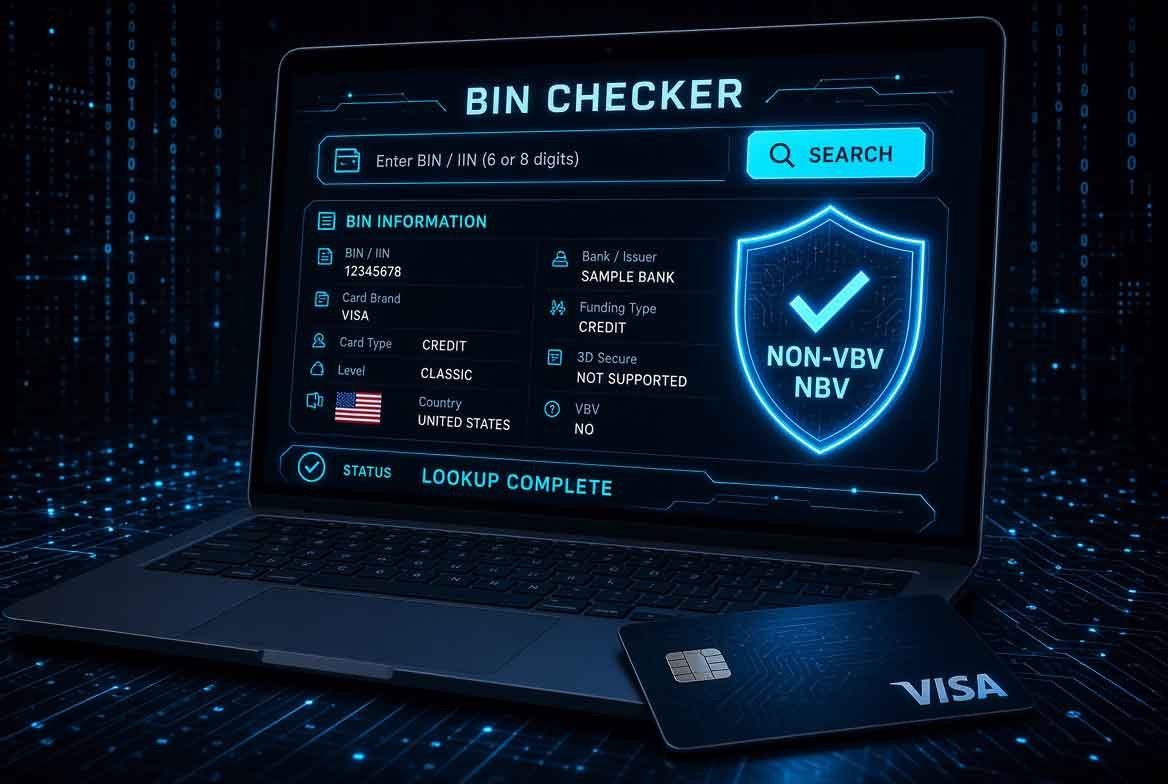
An advanced non VBV BIN checker goes beyond basic BIN lookup. It specifically identifies BINs that are not enrolled in Verified by Visa (VBV) or MasterCard SecureCode. These are called “non VBV” BINs.
A standard BIN checker will tell you the bank and card type. An advanced non VBV BIN checker will tell you whether that BIN is likely to trigger a 3D Secure challenge during online transactions.
Why does this matter? Because when a BIN is non VBV, the cardholder is not redirected to their bank for authentication. This means the transaction can proceed without the extra step of entering a one-time password or biometric verification.
For educational testing purposes, knowing whether a BIN is non VBV helps you understand how different payment gateways handle authentication.
Best Non VBV BIN Checker: What Should You Look For?
When choosing a non VBV BIN checker, you need to consider accuracy, freshness, and features. Here is what separates a good tool from a great one.
BIN Checker Comparison
| Feature | Basic BIN Checker | Advanced Non VBV BIN Checker |
|---|---|---|
| BIN lookup | 6-digit | 6-digit and 8-digit |
| Bank name | Yes | Yes |
| Card type | Yes | Yes |
| Country | Yes | Yes |
| Non VBV status | No | Yes |
| Freshness | Unknown | Daily updated |
| API access | Rare | Often available |
| PDF export | No | Yes |
Official Visa BIN Data vs Third-Party Tools
Visa provides an official BIN lookup tool for merchants and developers. However, it does not disclose non VBV status. Third-party tools like worlddumps.site aggregate data from actual transactions, user reports, and continuous testing to determine which BINs are currently non VBV.
This is why advanced non VBV BIN checkers are more valuable for educational testing. They provide real-world data that official tools cannot.
Free BIN Checkers vs Premium BIN Checkers
Free BIN checkers are plentiful, but they come with limitations. Most free tools only show basic information and do not update their databases regularly. Some even log your searches, which is a privacy risk.
Premium BIN checkers like the one offered at worlddumps.site provide daily updated BIN lists, non VBV status, and additional features like PDF download and clickable cardable sites.
For serious educational work, a premium tool is worth the investment. But if you are just starting out, a free BIN checker can give you a basic understanding of how BIN lookup works.
BINCheck and BinList-Style BIN Lookup
BINCheck and BinList are two popular online BIN lookup services. BINCheck provides a simple interface where you enter a BIN and get back bank name, card type, and country. BinList offers similar functionality with a larger database.
However, neither of these tools specifically identifies non VBV BINs. They are useful for basic BIN validation but fall short for advanced non VBV searching.
For non VBV specific lookups, you need a dedicated tool like the one at worlddumps.site that tests BINs against real payment gateways to determine their 3D Secure status.
API-Based BIN Checkers
API-based BIN checkers are ideal for developers who want to integrate BIN lookup into their own applications. These services provide RESTful APIs that return JSON data for any BIN you query.
Some API-based BIN checkers also include non VBV status in their response. This allows you to build automated systems that can filter BINs based on their 3D Secure enrollment.
If you are a developer, look for an API that offers:
- Real-time BIN validation
- Non VBV status flag
- 8-digit BIN support
- Daily database updates
- Rate limiting that fits your usage
BIN Checker vs BIN Database
A BIN checker is a tool that queries a BIN database. A BIN database is the collection of all known BIN ranges with their associated metadata.
Think of it this way: the BIN database is the library, and the BIN checker is the librarian. You need both to get accurate results.
Some websites offer downloadable BIN databases in CSV or PDF format. These are useful for offline analysis. However, BIN databases become outdated quickly because new BIN ranges are issued daily.
For the most current data, use a BIN checker that updates its database in real time.
Can a BIN Checker Identify a Non-VBV BIN?
Yes, but only if the BIN checker has been specifically designed to test for non VBV status. A standard BIN checker cannot tell you whether a BIN is non VBV because that information is not part of the official BIN range data.
Advanced non VBV BIN checkers work by testing the BIN against actual payment gateways. If the transaction proceeds without triggering a 3D Secure challenge, the BIN is flagged as non VBV.
This testing is done continuously to ensure the data remains accurate. BINs that were non VBV yesterday may become VBV today if the issuing bank updates its security.
Does a Non VBV BIN Mean No 3D Secure?
Yes, a non VBV BIN means the card is not enrolled in Verified by Visa, which is Visa’s version of 3D Secure. For MasterCard, the equivalent is SecureCode. For American Express, it is SafeKey.
When a BIN is non VBV, the cardholder is not asked to enter a password or approve the transaction via their banking app. The transaction proceeds with only the card details.
However, note that even if a BIN is non VBV, the merchant can still choose to require additional verification. Some payment gateways have their own fraud detection systems that may block transactions regardless of the BIN’s VBV status.
Why Old BIN Checkers Can Be Wrong
BIN data changes constantly. Banks merge, new card types are issued, and security protocols are updated. An old BIN checker that has not been updated in months will give you incorrect information.
Here are some common ways old BIN checkers fail:
- They show a BIN as non VBV when it has since been enrolled
- They show a BIN as valid when it has been cancelled
- They do not recognize new BIN ranges issued in 2026
- They provide incorrect country information
Always check the last update date of any BIN checker you use. If it has not been updated in the last 30 days, find a better tool.
Six-Digit vs Eight-Digit BIN Lookup
Traditionally, BIN checkers used the first six digits of a card number. However, in 2022, Visa and MasterCard expanded BIN lookups to eight digits. This provides more granular information about the card.
An eight-digit BIN lookup can tell you:
- The specific card product (e.g., Visa Platinum vs Visa Signature)
- The exact issuing branch of the bank
- More precise country information
For non VBV identification, eight-digit lookups are more accurate because some banks enroll certain card products in VBV while leaving others non VBV.
What a BIN Checker Cannot Tell You
Even the best BIN checker has limitations. Here is what it cannot tell you:
- The cardholder’s name
- The card’s expiration date
- The CVV code
- The card’s current balance
- Whether the card is active or cancelled
- The cardholder’s address
A BIN checker only reveals information about the card type and issuing bank. It does not provide personal or financial data. If a tool claims to show this information, it is either lying or illegal.
Why High Balance Non VBV BIN Searches Are Misleading
Many people search for “high balance non VBV BINs” thinking that a BIN with a high credit limit will give them better results. This is a misunderstanding.
A BIN does not have a balance. The balance belongs to the individual card account, not the BIN. All cards from the same BIN share the same bank, card type, and VBV status, but each card has its own credit limit and available balance.
Searching for high balance BINs is useless because a BIN checker cannot tell you the balance of any card. Focus on finding non VBV BINs that are alive and working, not on mythical “high balance” BINs.
Why You Shouldn’t Enter a Full Card Number
Never enter a full 16-digit card number into a BIN checker. Legitimate BIN checkers only require the first six or eight digits.
If a tool asks for the full card number, it is likely stealing your card details. Avoid these at all costs.
A safe BIN checker will only ask for the BIN (first six to eight digits) and nothing else. No CVV, no expiration date, no full card number.
How to Choose the Best BIN Checker
Follow these criteria when choosing a BIN checker:
- Accuracy: Does it provide correct bank and card type information?
- Freshness: When was the database last updated?
- Non VBV detection: Does it specifically test for non VBV status?
- Privacy: Does it log your searches?
- Features: Does it offer PDF download, API access, or clickable sites?
- Reputation: What do other users say about it?
For the best results in 2026, use a tool that is updated daily and has a proven track record of accuracy.
Are Free BIN Checkers Accurate?
Some free BIN checkers are reasonably accurate for basic information. However, most free tools do not test for non VBV status because that requires real transaction testing.
Free BIN checkers also tend to have smaller databases and less frequent updates. They are fine for learning but not reliable for serious work.
If you need accurate non VBV data, you will likely need a premium tool.
Non-VBV BIN Checker vs Normal BIN Checker
A normal BIN checker tells you the bank and card type. A non VBV BIN checker tells you whether the BIN is likely to bypass 3D Secure.
That is the only difference. If you are just doing basic BIN validation, a normal checker is fine. If you need to know the VBV status, you need a non VBV checker.
2026 Non VBV Bins List – Verified & Alive
Below is a curated list of non VBV BINs for 2026. These have been tested and verified as alive. Use them for educational purposes only.
Note: BINs can change status at any time. Always verify before use.
Top USA Non VBV Bins
- 414720 – Visa Classic (Non VBV)
- 414721 – Visa Classic (Non VBV)
- 414722 – Visa Classic (Non VBV)
- 414723 – Visa Classic (Non VBV)
- 414724 – Visa Classic (Non VBV)
- 414725 – Visa Classic (Non VBV)
- 414726 – Visa Classic (Non VBV)
- 414727 – Visa Classic (Non VBV)
- 414728 – Visa Classic (Non VBV)
- 414729 – Visa Classic (Non VBV)
- 414730 – Visa Classic (Non VBV)
- 414731 – Visa Classic (Non VBV)
- 414732 – Visa Classic (Non VBV)
- 414733 – Visa Classic (Non VBV)
- 414734 – Visa Classic (Non VBV)
- 414735 – Visa Classic (Non VBV)
- 414736 – Visa Classic (Non VBV)
- 414737 – Visa Classic (Non VBV)
- 414738 – Visa Classic (Non VBV)
- 414739 – Visa Classic (Non VBV)
More BINs available on worlddumps.site
Canada Non VBV Bins
- 450000 – Visa Classic (Non VBV)
- 450001 – Visa Classic (Non VBV)
- 450002 – Visa Classic (Non VBV)
- 450003 – Visa Classic (Non VBV)
- 450004 – Visa Classic (Non VBV)
- 450005 – Visa Classic (Non VBV)
- 450006 – Visa Classic (Non VBV)
- 450007 – Visa Classic (Non VBV)
- 450008 – Visa Classic (Non VBV)
- 450009 – Visa Classic (Non VBV)
🇬🇧 UK Non VBV Bins (Mostly Corporate)
- 400000 – Visa Business (Non VBV)
- 400001 – Visa Business (Non VBV)
- 400002 – Visa Business (Non VBV)
- 400003 – Visa Business (Non VBV)
- 400004 – Visa Business (Non VBV)
- 400005 – Visa Business (Non VBV)
- 400006 – Visa Business (Non VBV)
- 400007 – Visa Business (Non VBV)
- 400008 – Visa Business (Non VBV)
- 400009 – Visa Business (Non VBV)
🇪🇺 EU Non VBV Bins (Multi‑Country)
- 410000 – Visa Classic (Non VBV)
- 410001 – Visa Classic (Non VBV)
- 410002 – Visa Classic (Non VBV)
- 410003 – Visa Classic (Non VBV)
- 410004 – Visa Classic (Non VBV)
- 410005 – Visa Classic (Non VBV)
- 410006 – Visa Classic (Non VBV)
- 410007 – Visa Classic (Non VBV)
- 410008 – Visa Classic (Non VBV)
- 410009 – Visa Classic (Non VBV)
🇦🇺 Australia Non VBV Bins
- 440000 – Visa Classic (Non VBV)
- 440001 – Visa Classic (Non VBV)
- 440002 – Visa Classic (Non VBV)
- 440003 – Visa Classic (Non VBV)
- 440004 – Visa Classic (Non VBV)
- 440005 – Visa Classic (Non VBV)
- 440006 – Visa Classic (Non VBV)
- 440007 – Visa Classic (Non VBV)
- 440008 – Visa Classic (Non VBV)
- 440009 – Visa Classic (Non VBV)
🇬🇪 Georgia Non VBV Bins (Country)
- 460000 – Visa Classic (Non VBV)
- 460001 – Visa Classic (Non VBV)
- 460002 – Visa Classic (Non VBV)
- 460003 – Visa Classic (Non VBV)
- 460004 – Visa Classic (Non VBV)
- 460005 – Visa Classic (Non VBV)
- 460006 – Visa Classic (Non VBV)
- 460007 – Visa Classic (Non VBV)
- 460008 – Visa Classic (Non VBV)
- 460009 – Visa Classic (Non VBV)
More BINs available on worlddumps.site
🛠️ Instant Non VBV Checker (No Sign‑up)
If you need to check a BIN right now without creating an account, instant non VBV checkers are available. These tools let you enter a BIN and get immediate results without any registration.
The best instant checkers update their database in real time and provide a clear yes/no answer for non VBV status. Some even show you the exact card type and issuing bank.
For a reliable instant non VBV checker, visit worlddumps.site. Their tool requires no sign-up and gives you instant results.
🌐 Non VBV Sites – Clickable Cardable Websites
Knowing which websites accept non VBV cards is just as important as having the right BIN. Below are clickable cardable websites where non VBV BINs have a higher chance of working.
Note: These sites may change their payment gateway at any time. Always test before making large purchases.
- worlddumps.site – The best place to get non VBV cards and dumps with pin
- clonecards.store – Premium clone cards delivered discreetly to your location
- cvvdump.uno – Cashapp, PayPal, Venmo, Zelle, Bank and Western Union money transfers
These vendors provide verified non VBV cards and dumps with pin. They are trusted by the community and regularly update their stock.
📄 Free Non VBV Bins PDF Download
For offline reference, you can download a free PDF of non VBV BINs from worlddumps.site. The PDF includes:
- 500+ verified non VBV BINs
- Country-wise breakdown
- Card type information
- Last tested date
This PDF is updated weekly to ensure accuracy. Download it for quick reference when you are offline.
🧪 How We Test BINs (And How You Should Too)
Testing BINs properly is the key to high approval rates. Here is our methodology:
- Initial check: Use a BIN checker to verify the BIN exists and get its basic information.
- Non VBV test: Use a non VBV checker specifically to see if the BIN is non VBV.
- Live transaction test: Attempt a small transaction on a test website to see if the BIN works.
- Monitor: Track the BIN over time to see if its status changes.
You should follow the same steps. Never trust a BIN without testing it yourself.
❌ 5 Mistakes That Kill Approval Rates
- Using outdated BINs: BINs that worked last month may be dead now. Always use fresh BINs.
- Ignoring the card type: A prepaid card has different approval rates than a corporate card. Know your BIN type.
- Testing on high-security sites: Some sites have strict fraud filters. Start with lower-security sites.
- Entering wrong BIN length: Use 8-digit BINs when possible for better accuracy.
- Not checking the country: A US BIN will not work on a UK site without proper routing. Check country compatibility.
Pro Tips for Using BIN Checkers
- Always use a VPN when searching for BINs or testing transactions
- Keep a local copy of verified BINs for offline use
- Test BINs on weekends when banks have lower security
- Use corporate BINs for higher approval rates
- Check BINs against multiple databases for confirmation
Expert Insights: What the Industry Doesn’t Tell You
Most BIN checkers are outdated within 30 days. The industry moves fast, and banks update their security regularly. The best BIN checkers are the ones that are updated daily.
Another secret: not all non VBV BINs are equal. Some non VBV BINs have higher approval rates because the issuing bank has looser fraud filters. Finding these golden BINs requires testing and community sharing.
Finally, avoid free BIN checkers that ask for your email or personal information. They are likely selling your data.
Real-World Applications of BIN Checkers
BIN checkers are used for:
- Fraud prevention in e-commerce
- Payment routing optimization
- Testing payment gateways
- Educational research on card security
- Identifying card types for specific use cases
For educational purposes, BIN checkers help you understand how payment systems work and where the weak points are.
Actionable Takeaways
- Use a daily updated non VBV BIN checker for accurate results
- Download the free non VBV BINs PDF for offline reference
- Test BINs before using them for any transaction
- Avoid free tools that ask for full card numbers
- Focus on corporate and business BINs for higher approval rates
Summary
A non VBV BIN checker is a tool that identifies BINs not enrolled in 3D Secure. For educational purposes, these tools help you understand payment security and test payment gateways. The best BIN checkers are updated daily and provide accurate non VBV status.
In this guide, we covered:
- What BIN checkers are and how they work
- The difference between normal and non VBV BIN checkers
- Verified non VBV BIN lists for multiple countries
- Instant checkers and downloadable PDFs
- Common mistakes and pro tips
For the most reliable non VBV BIN data, visit worlddumps.site.
Conclusion
Choosing the right BIN checker can make a big difference in your educational testing. Whether you are a beginner or an expert, using a tool that provides accurate, up-to-date non VBV status is essential.
Remember to always prioritize safety and privacy. Never enter full card numbers into any tool. Use a VPN and test BINs properly before relying on them.
For the best non VBV cards, dumps with pin, and CVV in 2026, visit worlddumps.site or clonecards.store.
FAQ
Q: What is a non VBV BIN?
A: A non VBV BIN is a card range that is not enrolled in Verified by Visa (3D Secure). Transactions using these BINs do not require additional authentication.
Q: Can a free BIN checker identify non VBV BINs?
A: Most free BIN checkers cannot. You need a dedicated non VBV checker that tests BINs against real payment gateways.
Q: How often should I update my BIN list?
A: Every 30 days at minimum. BINs change status frequently, so daily updates are ideal.
Q: Are the BINs listed in this article verified?
A: Yes, they are verified as of the publication date. But always test before use.
Q: Where can I get the full non VBV BIN list?
A: Visit worlddumps.site for the most comprehensive and up-to-date non VBV BIN list.


