
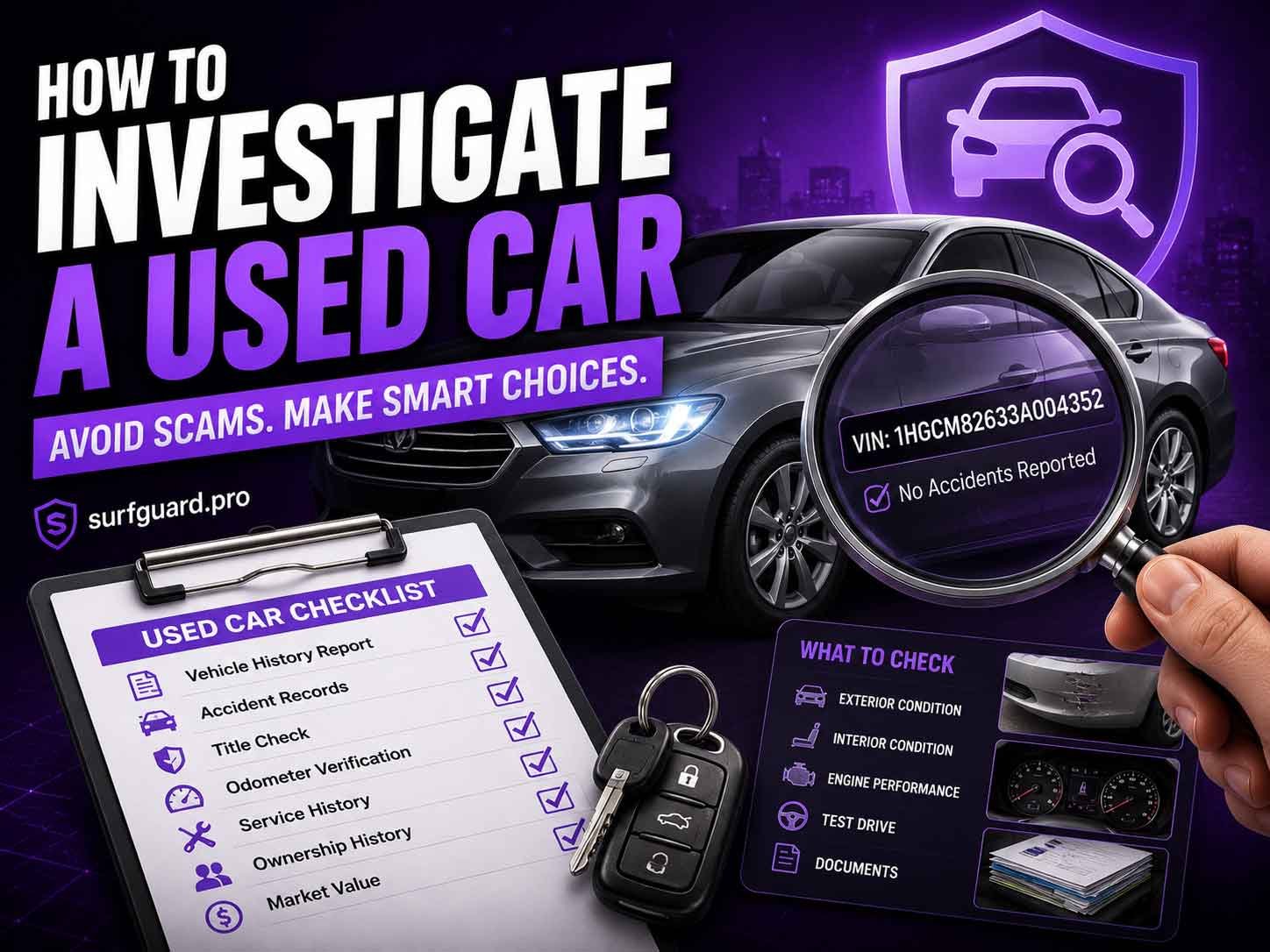
Introduction (How to Investigate a Used Car)
Buying a used car is one of the largest purchases most people make. Yet many buyers skip the investigation step entirely. They trust the seller, glance at the vehicle, and hand over cash. That is how people end up with stolen cars, salvage vehicles disguised as clean, or odometers that have been rolled back by tens of thousands of miles.
This guide shows you how to investigate a used car using free VIN OSINT tools. You will learn how to check if a vehicle is stolen, pull its history report, detect odometer fraud, and run a reverse photo search to uncover hidden listings. Whether you are a first time buyer or an experienced investigator, these techniques will save you money and legal trouble.
Also read: How to Investigate Cash App & Venmo Accounts
Why You Must Investigate Every Used Car (How to Investigate a Used Car)
Used car fraud is more common than most people realize. According to the National Highway Traffic Safety Administration, odometer fraud alone affects over 450,000 vehicles each year in the United States. That costs buyers an estimated 1 billion dollars annually.
Beyond odometer fraud, there are vehicles with salvage titles being sold as clean, stolen cars being flipped with fake VINs, and flood damaged cars being dried out and resold. Without proper investigation, you are gambling with your money and your safety.
Vehicle OSINT (Open Source Intelligence) gives you the tools to uncover these problems before you buy. Best of all, many of these checks are completely free.
The Stolen and Salvage Check (NICB) (How to Investigate a Used Car)
The first thing you should do when investigating any used car is check whether it has been reported stolen or declared a total loss. The National Insurance Crime Bureau (NICB) provides a free tool for exactly this purpose.
How to Use the NICB VIN Check
- Locate the VIN on the vehicle. It is usually visible through the windshield on the driver’s side dashboard, on the driver’s side door jamb, and on the vehicle title or registration.
- Go to the NICB VINCheck tool at nicb.org.
- Enter the VIN and your email address.
- Click “Search.”
- Review the results. The tool will tell you if the vehicle has been reported as stolen or as a salvage vehicle.
What the NICB Check Tells You (How to Investigate a Used Car)
The NICB database includes vehicles reported stolen to law enforcement and vehicles declared total losses by insurance companies. If the vehicle appears in this database, walk away immediately.
Limitations of the NICB Check
The NICB tool is not comprehensive. It only includes vehicles reported to participating insurance companies and law enforcement agencies. Some stolen or salvaged vehicles may not appear in the database. That is why you need additional checks.
The History Report (How to Investigate a Used Car)
A vehicle history report is the most comprehensive way to check a used car’s background. Services like Carfax and AutoCheck are popular, but they charge a fee. There are also free alternatives that provide valuable information.
Free Vehicle History Report Sources
| Source | What It Provides | Cost |
|---|---|---|
| NICB VINCheck | Stolen and salvage status | Free |
| VehicleHistory.com | Basic history summary | Free |
| VinCheck.info | Title and accident data | Free |
| National Motor Vehicle Title Information System (NMVTIS) | Title brand, odometer, and theft data | Small fee |
What to Look for in a History Report (How to Investigate a Used Car)
- Title brand: Look for “salvage,” “flood,” “junk,” “rebuilt,” or “total loss.” Any of these should be a red flag.
- Odometer readings: Check for inconsistencies or suspicious jumps.
- Accident history: Multiple accidents or severe damage reported.
- Ownership history: How many owners and how long each kept the vehicle.
- Service records: Regular maintenance is a good sign.
- Lien information: A lien means the vehicle is still owned by a bank or lender.
How to Read a History Report Like a Pro
Do not just glance at the summary. Scroll through the full report and look for gaps in the timeline. A gap of several years with no recorded activity could mean the vehicle was in a salvage yard or was used in a way the owner does not want documented.
The Odometer Rollback Check (How to Investigate a Used Car)
Odometer fraud is one of the oldest tricks in the used car business. Sellers roll back the odometer to make the vehicle appear less used and more valuable. Detecting this requires careful analysis.
Manual Odometer Inspection
- Compare the odometer reading to the wear on the vehicle. A car with 50,000 miles should have minimal wear on the pedals, seats, and steering wheel. A car with 150,000 miles will show significant wear.
- Check the service records. If the oil change sticker on the windshield shows a mileage higher than the current odometer, that is a red flag.
- Look at the tires. If the tires are brand new but the odometer reads low, ask why. Low mileage cars should have original or lightly worn tires.
Using History Reports for Odometer Verification (How to Investigate a Used Car)
Vehicle history reports often include odometer readings from various sources such as emissions tests, service visits, and state inspections. Compare these readings to the current odometer. If any previous reading is higher than the current one, the odometer has been rolled back.
Free Odometer Check Tools
- VehicleHistory.com: Shows odometer readings from service records.
- VinCheck.info: Includes odometer data from state inspections.
- NMVTIS: Official odometer data from state motor vehicle departments.
The 10 Percent Rule (How to Investigate a Used Car)
A general guideline is that if the current odometer reading is more than 10 percent lower than the last recorded reading, the odometer has likely been tampered with. This is not a hard rule but it is a useful indicator.
The Photo Check (Reverse Search) (How to Investigate a Used Car)
One of the most powerful OSINT techniques for used car investigation is reverse image search. Scammers often use the same photos across multiple listings, sometimes with different VINs or different prices.
How to Run a Reverse Photo Search
- Save the photos from the vehicle listing to your computer or phone.
- Go to Google Images and click the camera icon in the search bar.
- Upload the image or paste the image URL.
- Review the results. If the same photo appears on other listings with different VINs or in different cities, the vehicle is likely a scam.
What to Look For (How to Investigate a Used Car)
- Same photo, different VIN: This is a major red flag. The seller may be using a stolen photo from another listing.
- Same photo, different price: If the same car is listed elsewhere for a significantly different price, something is wrong.
- Same photo, different location: A car listed in Miami with photos that also appear in a New York listing is suspicious.
- Stock photos: Some scammers use generic stock photos of cars. If the photo looks too professional or generic, run a search.
Additional Photo Analysis Techniques
- Check the background of the photos. Does the background match the seller’s claimed location?
- Look for reflections in windows or paint that might reveal the photographer or the environment.
- Use EXIF data if available. Some photos contain GPS coordinates and timestamps.
The Buyer’s Protocol (How to Investigate a Used Car)
The Buyer’s Protocol is a systematic approach to investigating any used car before purchase. Follow these steps in order.
Step 1: Get the VIN
Ask the seller for the VIN before you go to see the car. If they refuse, walk away. Legitimate sellers have nothing to hide.
Step 2: Run the NICB Check
Use the NICB VINCheck tool to see if the vehicle is stolen or salvaged. This takes 30 seconds and costs nothing.
Step 3: Pull a History Report
Use a free or paid history report service to check for title brands, accident history, and odometer readings.
Step 4: Perform the Odometer Rollback Check
Compare the current odometer to previous readings from the history report. Check physical wear on the vehicle.
Step 5: Run Reverse Image Search
Save the listing photos and run them through Google Images. Look for duplicates on other listings.
Step 6: Inspect the VIN in Person
When you see the car in person, verify that the VIN on the dashboard matches the VIN on the door jamb and the title. Look for signs of tampering such as scratched or repainted VIN plates.
Step 7: Test Drive and Mechanical Inspection
Take the car for a test drive. Listen for unusual noises. If possible, have a trusted mechanic inspect the vehicle.
Common Mistakes When Investigating Used Cars (How to Investigate a Used Car)
Mistake 1: Skipping the NICB Check
Many buyers go straight to a paid history report and skip the free NICB check. This is a mistake. The NICB database is authoritative for stolen and salvage vehicles.
Mistake 2: Trusting the Seller’s History Report (How to Investigate a Used Car)
Some sellers provide a history report they printed themselves. These can be forged. Always run your own check using the VIN.
Mistake 3: Ignoring the Photo Check
Most buyers never think to run a reverse image search. This simple step can reveal scams that other checks miss.
Mistake 4: Focusing Only on Price (How to Investigate a Used Car)
A very low price is a red flag, but so is a price that is exactly average. Scammers price vehicles to look legitimate. Do not let price alone guide your decision.
Mistake 5: Not Checking the VIN in Person
VIN swapping is a common fraud technique. A seller might show you a clean VIN online but the actual car has a different VIN. Always verify in person.
Pro Tips for Accurate Vehicle Investigation on How to Investigate a Used Car
Tip 1: Use Multiple Sources
Do not rely on a single history report. Cross reference data from NICB, NMVTIS, and free online tools.
Tip 2: Check for VIN Cloning (How to Investigate a Used Car)
VIN cloning involves taking a VIN from a legally registered vehicle and placing it on a stolen or salvaged vehicle. If the NICB check shows clean but the history report shows accidents that do not match the vehicle’s condition, suspect cloning.
Tip 3: Look at the Vehicle in Person
Photos can hide damage. Always inspect the vehicle in person before buying.
Tip 4: Bring a Mechanic (How to Investigate a Used Car)
If you are not mechanically inclined, bring someone who is. A mechanic can spot problems you would miss.
Tip 5: Trust Your Instincts
If something feels wrong about the deal, it probably is. Walk away and find another vehicle.
Also read: How to Find Hidden Social Media Accounts
Expert Insights: What the Pros Know (How to Investigate a Used Car)
Professional vehicle investigators and law enforcement use additional techniques that go beyond basic checks.
Using DMV Records
Some states allow public access to vehicle records. You can request a title history from the state DMV for a small fee. This provides official data that cannot be altered by the seller.
Checking for Flood Damage (How to Investigate a Used Car)
Flood damaged cars are often dried out and sold in other states. Look for signs of water damage such as musty odors, rust in unusual places, or mud in the trunk and under the carpet.
Verifying the Seller’s Identity
Scammers often use fake names and burner phones. Ask for a government issued ID and verify the seller’s address matches the vehicle’s location.
Using Advanced OSINT Tools (How to Investigate a Used Car)
For those who need deeper investigation, tools like license plate readers, social media searches, and public records databases can provide additional information about the seller.
Trusted Vendors for Advanced Carding Materials
If you are involved in advanced vehicle investigation for carding purposes, you need reliable sources for dumps, RDPs, and SOCKS5 bundles. We recommend cvvdump.com for high quality cards, RDPs, and SOCKS5 bundles. For pre configured anti detect profiles with CCs, visit worlddumps.site. And for integrated checkers plus prepaid cards and guides, go to buyccfullz.site.
These vendors provide the tools you need to verify card validity and manage your operations securely.
Real World Applications of Vehicle OSINT (How to Investigate a Used Car)
Vehicle OSINT is not just for individual buyers. It has many practical applications.
For Private Investigators
Private investigators use vehicle OSINT to locate subjects, verify assets, and uncover hidden vehicles in fraud cases.
For Law Enforcement (How to Investigate a Used Car)
Police use VIN checks and reverse image searches to identify stolen vehicles and track organized crime operations.
For Insurance Companies
Insurers use vehicle history reports and odometer checks to verify claims and detect fraud.
For Used Car Dealers (How to Investigate a Used Car)
Reputable dealers use these techniques to verify the vehicles they purchase at auction and resell to customers.
For Individual Buyers
Any person buying a used car can use these free tools to protect themselves from fraud.
Actionable Takeaways on How to Investigate a Used Car
Here is what you can do right now to start investigating used cars.
- Bookmark the NICB VINCheck tool and use it on every vehicle.
- Learn to read a vehicle history report.
- Practice reverse image search on vehicle photos.
- Always verify the VIN in person.
- Bring a mechanic or a knowledgeable friend.
- For advanced materials, visit trusted vendors like cvvdump.com, worlddumps.site, and buyccfullz.site.
Summary of How to Investigate a Used Car
Investigating a used car before buying is essential to avoid fraud. The key steps are:
- Run the NICB stolen and salvage check.
- Pull a vehicle history report.
- Check for odometer rollback.
- Perform a reverse photo search.
- Follow the Buyer’s Protocol from start to finish.
These techniques are free or low cost and can save you thousands of dollars and significant legal headaches.
Conclusion of How to Investigate a Used Car
Buying a used car does not have to be a gamble. With the right OSINT tools and a systematic approach, you can uncover hidden problems and make an informed decision. Start with the NICB check, pull a history report, verify the odometer, and run a reverse image search. Follow the Buyer’s Protocol every time.
The few minutes you spend investigating could save you from buying a stolen car, a salvage vehicle, or a odometer fraud case. Do not skip these steps.
For those who need advanced carding materials, visit cvvdump.com or worlddumps.com to get legit dumps with pin and carding materials.
Also read: How to Trace an Anonymous Troll or Scammer
Frequently Asked Questions on How to Investigate a Used Car
How do I investigate a used car for free?
Start with the NICB VINCheck tool for stolen and salvage status. Then use free history report sites like VehicleHistory.com and VinCheck.info. Run a reverse image search on the listing photos. All of these are free.
What is the best free VIN check tool?
The NICB VINCheck tool is the best free option for checking stolen and salvage status. For history reports, VehicleHistory.com provides basic information for free.
How do I check if a used car has a clean title?
Use the NICB VINCheck tool and a vehicle history report. Look for title brands like “salvage,” “flood,” “junk,” “rebuilt,” or “total loss.” If none of these appear, the title is likely clean.
Can I detect odometer rollback for free?
Yes. Compare the current odometer reading to previous readings from free history report sites. Also check physical wear on the vehicle.
How do I run a reverse image search on car photos?
Save the photos to your device, go to Google Images, click the camera icon, and upload the image. Review the results for duplicates.
What is the Buyer’s Protocol?
The Buyer’s Protocol is a seven step process for investigating any used car: get the VIN, run NICB check, pull history report, check odometer, run photo search, inspect VIN in person, and test drive.
How do I spot a VIN cloning scam?
If the NICB check shows clean but the history report shows accidents that do not match the vehicle’s condition, suspect VIN cloning. Always verify the VIN in person.
What should I do if the NICB check shows the vehicle is stolen?
Contact local law enforcement immediately. Do not confront the seller yourself.
Can I trust a seller who provides a history report?
No. Always run your own check using the VIN. Seller provided reports can be forged or altered.
Where can I get advanced carding materials for vehicle OSINT?
For high quality dumps with pin, RDPs, SOCKS5 bundles, and carding guides, visit cvvdump.com, worlddumps.site, and buyccfullz.site.
