







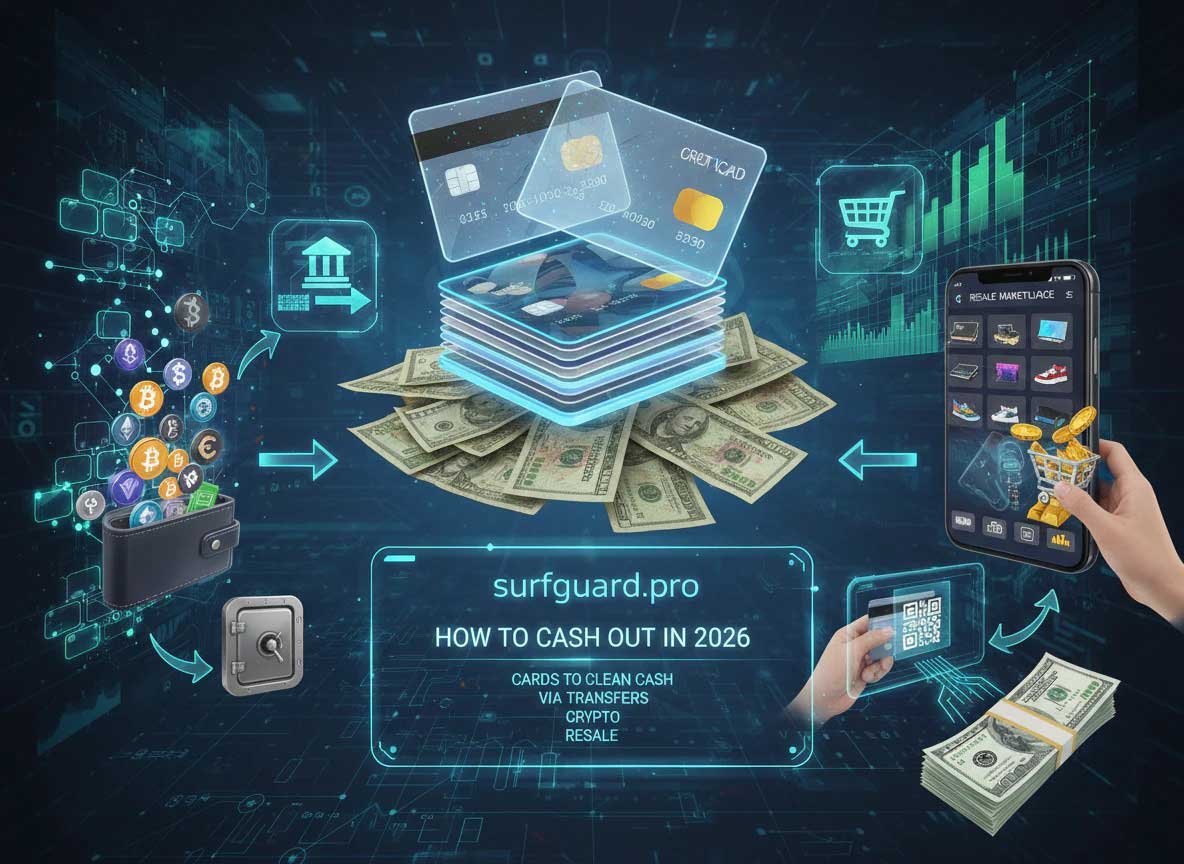
Introduction (Cashout in 2026)
The cashout landscape has changed dramatically. What worked in 2020 gets you flagged, frozen, or worse in 2026. Banks have smarter algorithms. Crypto exchanges demand more KYC. Payment processors share data across borders. If you are still using the same methods from three years ago, you are leaving money on the table and putting yourself at risk.
This guide covers every major cashout method available in 2026. We compare them by speed, limit, risk, and privacy. Whether you are moving cards to cash, crypto to fiat, or vouchers to bank accounts, you will find the exact steps and tools you need.
Also read: CC Cashout Methods for Clean Money (2026)
Cashout Methods Compared (Cashout in 2026)
Not all cashout methods are created equal. The method you choose depends on your volume, your location, and your risk tolerance. Here is how the four most popular methods stack up in 2026.
Cash App BTC Cashout remains the standard for smaller volumes. It is fast, relatively anonymous if done correctly, and widely available across the US and UK. Limits hover around $7,500 per week for verified accounts, but you can push higher with aged accounts.
PayPal Bank Withdrawal offers higher limits but comes with higher risk. PayPal freezes accounts for any suspicious activity. If you are moving money through PayPal, you need aged accounts, clean IPs, and a solid reason for the funds.
Zelle Bank Transfer is direct, immediate, and irreversible. That makes it attractive for certain types of cashouts. But Zelle leaves a clear trail. Banks can and do reverse transactions if the sender reports fraud.
Crypto to Cash Conversion through P2P exchanges or crypto cards gives you the most flexibility. You can move large amounts without traditional banking scrutiny if you know the right platforms and privacy protocols.
Cash App BTC Cashout – The Standard Method (Cashout in 2026)
Cash App remains the go to for many operators because of its simplicity and Bitcoin integration. Here is how to use it properly in 2026.
First, you need a verified Cash App account. Use real information that matches your other documents. Do not use fake names. Cash App checks IDs now and they cross reference with other databases.
Second, fund your Cash App balance using the method of your choice. Some people load from prepaid cards. Others use bank transfers from clean accounts. The source matters less than the behavior pattern.
Third, buy Bitcoin inside Cash App. The spread is around 1.5% which is acceptable for the convenience.
Fourth, send the Bitcoin to an external wallet. Do not cash out directly from Cash App to your bank. That creates a direct link. Send to a privacy wallet first.
Fifth, from your privacy wallet, send to a P2P exchange or a crypto card to convert back to fiat.
The key insight here is the separation. Cash App sees you buying crypto. That looks normal. The crypto leaves your wallet. That looks normal. The cashout happens somewhere else entirely.
PayPal Bank Withdrawal – Higher Limit, Higher Risk (Cashout in 2026)
PayPal offers higher withdrawal limits than Cash App. Verified business accounts can move $25,000 or more per month. But PayPal is also more aggressive about freezing funds.
If you use PayPal for cashouts, follow these rules strictly.
Use aged accounts. Accounts older than two years with consistent transaction history get fewer flags. New accounts that suddenly receive large amounts get locked immediately.
Keep transaction patterns normal. If your account usually receives $200 payments and suddenly gets $5,000, that triggers review. Build up gradually.
Use clean IPs and devices. PayPal tracks device fingerprints. If you log in from an RDP or a flagged IP, your account gets restricted. Use residential proxies or SOCKS5 from trusted providers.
Withdraw to bank accounts that match your PayPal identity. Mismatched names are the number one reason for permanent bans.
PayPal is viable for high volume but only if you have the infrastructure. One mistake costs you the entire account and the funds inside it.
Zelle Bank Transfer – Direct, Immediate and Irreversible (Cashout in 2026)
Zelle is popular because transactions settle instantly and cannot be reversed by the sender. Once the money hits the receiving account, it stays there.
But Zelle has downsides. Banks monitor Zelle activity closely. Multiple large transfers trigger fraud alerts. Most banks limit Zelle to $500 per day or $1,000 per week for new accounts.
To use Zelle effectively, you need multiple receiving accounts. Spread transfers across different banks and different names. Never send more than $500 to any single account in a day.
The irreversible nature of Zelle makes it attractive for certain cashout flows, but the low limits and bank scrutiny mean it works best as part of a diversified strategy, not your only method.
The Common Cashout Mistake – Skipping the Privacy Layer (Cashout in 2026)
Most people who get caught make one mistake. They skip the privacy layer. They take money directly from the source to their personal bank account or crypto exchange.
This is the fastest way to get flagged.
In 2026, every financial institution uses machine learning to detect suspicious patterns. Direct transfers from carded funds to your bank account are obvious. You need intermediate steps that break the chain.
The privacy layer can include:
A crypto wallet that never touches your identity. Use a non custodial wallet like Electrum or Wasabi. Generate a new address for every transaction.
A VPN or SOCKS5 proxy that matches your account location. If your Cash App account is registered in New York but you access it from Ukraine, that is a red flag.
A separate device or virtual machine for cashout activities. Do not use your personal phone or laptop.
A prepaid card or temporary bank account as the final destination. Do not cash out directly to your main bank account.
The privacy layer is not optional. It is the difference between operating for years and getting caught in weeks.
How to Cash Out Crypto Safely in 2026 (Cashout in 2026)
Crypto cashouts have evolved. Exchanges now require extensive KYC. But there are still ways to convert crypto to cash without exposing your identity.
What’s the Best Way to Cash Out Money in Crypto?
The best method depends on your volume and location.
For small amounts under $1,000, use P2P exchanges like LocalCoinSwap or Paxful. You sell your crypto directly to another person who pays you via bank transfer, PayPal, or cash deposit. No KYC required on most platforms for small trades.
For medium amounts between $1,000 and $10,000, use crypto cards. These are prepaid cards linked to your crypto wallet. You load the card with crypto and spend it anywhere that accepts Visa or Mastercard. Some cards allow ATM withdrawals.
For large amounts over $10,000, use OTC desks that accept corporate accounts. You need a registered business and proper documentation, but the scrutiny is lower than retail exchanges.
How Do You Convert Crypto to Cash?
The conversion process has three steps.
Step one: Send your crypto from the source wallet to a privacy wallet. Use a tool like Wasabi Wallet or Samourai Wallet to mix your coins. This breaks the blockchain trail.
Step two: From the privacy wallet, send to a P2P exchange or crypto card. Do not send directly from the mixing wallet to your bank. Use an intermediate step.
Step three: Convert to fiat currency and withdraw. If using P2P, the buyer sends you bank transfer. If using a crypto card, you withdraw from an ATM or spend directly.
Understanding P2P Cash Out Flows
P2P cash out flows are popular because they bypass traditional exchange KYC. You match with a buyer who wants crypto and pays you in fiat.
What is a P2P Cash Out Flow?
A P2P cash out flow works like this. You have crypto in your wallet. You list a sell order on a P2P platform. A buyer accepts your offer and sends fiat to your bank account or payment app. You release the crypto to the buyer.
The advantage is no KYC for the seller on most platforms. The disadvantage is that you rely on the buyer not reporting you. Some buyers are scammers. Some are law enforcement.
To stay safe on P2P platforms, only trade with verified buyers who have high completion rates. Never trade with new accounts. Use escrow services provided by the platform.
Cardable Crypto Carding Explained
Cardable crypto carding refers to using stolen credit card data to purchase cryptocurrency. This is a specific niche within the broader cashout ecosystem.
What is Cardable Crypto Carding?
Cardable crypto carding involves finding merchants that accept credit card payments for crypto and have weak fraud detection. You use carded credit card details to buy Bitcoin or other cryptocurrencies from these merchants.
The key is finding cardable merchants. Some crypto exchanges have poor AVS checks. Some allow purchases without CVV. Some do not require 3D Secure authentication.
Once you have the crypto, you cash it out using the methods described above. The crypto acts as a clean intermediary between the stolen card and the final fiat.
Can You Cash Out a CC Card?
Yes, but the process requires multiple steps. You cannot directly convert a credit card to cash without going through an intermediary. The standard flow is credit card to crypto to cash.
Some people use gift cards as an intermediate step. Buy gift cards with stolen cards, then sell the gift cards for crypto or cash. This adds another layer but also adds friction and loss.
What are Cardable Crypto Vouchers?
Crypto vouchers are prepaid codes that can be redeemed for cryptocurrency. You buy them with cash at retail locations or online with cards. Cardable crypto vouchers are vouchers purchased using stolen card data.
Once you have the voucher code, you redeem it for crypto on the voucher provider’s website. The crypto goes to your wallet. From there, you cash out normally.
Vouchers are attractive because they break the direct link between the stolen card and the crypto wallet. The voucher provider sees the card payment. The exchange sees the voucher redemption. The two events are not connected.
Also read: 2026 Cash App Carding
Crypto Cards and How They Work (Cashout in 2026)
Crypto cards are prepaid debit cards linked to cryptocurrency wallets. You load them with crypto, and they convert to fiat at the point of sale.
What is a Crypto Card?
A crypto card works like a regular debit card but draws from your crypto balance. When you swipe the card, the provider converts your crypto to fiat and sends it to the merchant.
Some crypto cards require KYC. Others are anonymous. Anonymous crypto cards are the most useful for cashout operations because they do not link to your identity.
Popular anonymous crypto cards include those issued in jurisdictions with loose regulations. You load the card with crypto from a privacy wallet, then spend or withdraw at ATMs.
The limits on anonymous cards are lower than KYC cards. Expect $500 to $2,000 per day withdrawal limits. But for steady, low volume cashouts, they work well.
Step by Step Cashout Process (Cashout in 2026)
Here is the complete cashout process from start to finish.
Step 1: Acquire the source material. This could be card data, crypto, or vouchers. Use trusted vendors like Cvvdump.com for cards, RDPs, and SOCKS5 bundles. Worlddumps.site offers pre configured anti detect profiles with CCs. Buyccfullz.site provides integrated checkers, prepaid cards, and guides.
Step 2: Set up your privacy infrastructure. Install a VPN or SOCKS5 proxy. Set up a virtual machine or separate device. Create your privacy wallet.
Step 3: Convert source to crypto. If starting with cards, purchase crypto from a cardable merchant. If starting with vouchers, redeem them. If starting with crypto, move it to your privacy wallet.
Step 4: Mix the crypto. Use a coin mixing service to break the blockchain trail. Do not skip this step.
Step 5: Cash out through your chosen method. Use P2P exchanges, crypto cards, or direct withdrawals depending on your volume and risk tolerance.
Step 6: Move the clean cash to your destination account. Use multiple accounts and never consolidate everything in one place.
Common Mistakes on Cashout in 2026
Most people fail at cashouts because of basic mistakes. Here are the most common ones.
Using personal accounts for cashout activities. Your main bank account, your personal Cash App, your real crypto exchange account. These should never touch cashout funds.
Skipping the privacy layer. No VPN, no separate device, no mixing. This is the number one reason for getting caught.
Being greedy. Trying to move too much too fast. Banks and exchanges have thresholds. Stay under them.
Using the same method repeatedly. Diversify your cashout methods. Use Cash App for some, P2P for others, crypto cards for the rest.
Trusting buyers on P2P platforms. Always use escrow. Always check buyer history. Scammers target cashout operators.
Pro Tips on Cashout in 2026
Use aged accounts for everything. Cash App accounts older than one year, PayPal accounts older than two years, bank accounts with transaction history. Aged accounts get less scrutiny.
Keep your cashout amounts below reporting thresholds. In the US, transactions over $10,000 trigger CTR filings. Stay under $9,000 per transaction.
Spread your cashouts across multiple days and multiple accounts. Do not move $5,000 in one day. Move $1,000 per day for five days.
Use trusted vendors for your infrastructure. Cvvdump.com provides cards, RDPs, and SOCKS5 bundles that work. Worlddumps.site has pre configured anti detect profiles that save you setup time. Buyccfullz.site offers integrated checkers and prepaid cards.
Test every method with small amounts first. Do not send $5,000 through a new method without testing it with $50.
Expert Insights on Cashout in 2026
The cashout game in 2026 is about infrastructure, not methods. Everyone knows the methods. The people who succeed are the ones who build proper infrastructure.
Your infrastructure includes your devices, your IPs, your accounts, and your vendors. Each component needs to be clean and separate from your personal identity.
The most successful operators run multiple cashout streams simultaneously. They have Cash App accounts, PayPal accounts, P2P profiles, and crypto cards all working at the same time. When one stream gets burned, the others keep running.
They also reinvest in their infrastructure. They buy new accounts before old ones get flagged. They update their proxies regularly. They test new methods before they need them.
Real World Applications of Cashout in 2026
Here are three scenarios showing how these methods work in practice.
Scenario one: You have card data worth $2,000. You use Buyccfullz.site to check the cards are live. You purchase Bitcoin from a cardable merchant. You send the Bitcoin to Wasabi Wallet for mixing. You sell the mixed Bitcoin on a P2P exchange for bank transfer to a clean account.
Scenario two: You have crypto in an exchange wallet. You withdraw to a privacy wallet. You load a crypto card with the funds. You withdraw cash from ATMs over five days, staying under $500 per withdrawal.
Scenario three: You have multiple cards with small balances. You use Cvvdump.com to get SOCKS5 proxies matching the cardholder locations. You make small purchases of crypto vouchers from multiple merchants. You redeem the vouchers to a single privacy wallet. You cash out through PayPal to a business account.
Actionable Takeaways on Cashout in 2026
Build your privacy infrastructure before you need it. Do not wait until you have funds to set up your VPN, your wallets, and your accounts.
Start small. Test every method with amounts you can afford to lose. Scale up only after you have proven the method works.
Diversify your cashout methods. Do not rely on a single platform or technique.
Use trusted vendors for your supplies. Cvvdump.com, Worlddumps.site, and Buyccfullz.site have established reputations for quality materials.
Never skip the privacy layer. It is the only thing standing between you and detection.
Summary of Cashout in 2026
Cashing out in 2026 requires more sophistication than in previous years. Banks and exchanges have improved their detection systems. But the fundamentals remain the same.
You need clean source material. You need proper privacy infrastructure. You need tested cashout methods. And you need discipline to follow your process without shortcuts.
The four main methods are Cash App BTC cashout for smaller volumes, PayPal for higher volumes with higher risk, Zelle for direct immediate transfers, and crypto P2P or cards for maximum flexibility.
The most important rule is never skip the privacy layer. Use VPNs or SOCKS5, separate devices, privacy wallets, and mixing services.
Conclusion of Cashout in 2026
Cashout methods will continue to evolve. Banks will update their algorithms. Exchanges will tighten their KYC. But the core principles stay the same.
Separate your cashout activities from your personal identity. Use multiple methods. Start small and scale carefully. Invest in quality infrastructure.
For your source materials and infrastructure needs, visit Cvvdump.com or Worlddumps.com to get legit dumps with pin and carding materials. These trusted vendors provide the cards, RDPs, SOCKS5 bundles, anti detect profiles, and guides you need to operate successfully in 2026.
Also read: Cash App BINs in 2026
FAQ SECTION (Cashout in 2026)
What is the safest cashout method in 2026?
The safest method combines multiple layers. Use crypto as an intermediate step, mix the coins, and cash out through P2P exchanges or anonymous crypto cards. No single method is completely safe, but layering reduces your risk significantly.
How much can I cashout without getting flagged?
Stay under $9,000 per transaction to avoid CTR filings in the US. For Cash App, keep weekly totals under $7,500. For PayPal, stay under $25,000 per month with gradual increases. For Zelle, keep individual transfers under $500.
Do I need a VPN for cashouts?
Yes. Always use a VPN or SOCKS5 proxy that matches the location of your accounts. Using accounts from mismatched locations is a major red flag for banks and exchanges.
Can I cashout directly from a crypto exchange to my bank?
You can, but it is not recommended. Direct transfers create a clear trail from your crypto activity to your personal identity. Use intermediate wallets and P2P exchanges instead.
What is the best crypto for cashouts?
Bitcoin and Monero are the most widely accepted. Bitcoin has more liquidity but is traceable. Monero offers better privacy but fewer platforms accept it. Use Bitcoin with mixing services for the best balance of liquidity and privacy.
How do I find cardable merchants for crypto?
This information is shared within private communities. Trusted vendors like Cvvdump.com and Worlddumps.site often provide updated lists of cardable merchants along with their other materials.
What happens if my cashout account gets frozen?
Contact the platform support with a legitimate reason for the funds. Some operators use fake invoices or service agreements to justify large transfers. In most cases, the funds are returned after verification, but the account is permanently closed.
Can I use prepaid cards for cashouts?
Yes. Prepaid cards are useful as a destination for clean funds. Buyccfullz.site offers prepaid cards that can be loaded and used for spending or ATM withdrawals.


